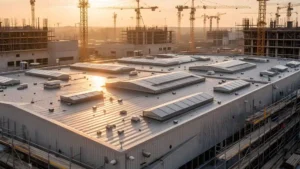
Commercial roof storm damage restoration is a process that catches most building owners and property managers completely unprepared, not because the storms are unexpected, but because the gap between what a commercial roof looks like after a storm and what is actually happening beneath the surface is far wider than most people realize. A commercial flat roof can sustain significant structural and membrane damage from a single hail or wind event and show almost no visible surface signs that would alarm an untrained observer walking the building perimeter.
By the time interior ceiling tiles are staining, insulation is saturated, and HVAC equipment mounted on the roof is leaking at its curb flashings, the damage has already compounded through one or more additional rain events into a restoration scope that dwarfs what early intervention would have cost. This guide covers everything building owners and property managers need to know to respond correctly when a storm hits a commercial roof.
What is Commercial Roof Storm Damage Restoration? (The Simple Definition)
Commercial roof storm damage restoration is the complete process of assessing, documenting, stabilizing, and permanently repairing or replacing a commercial roofing system that has been damaged by a storm event, including hail, high wind, lightning, flooding, or wind-driven rain. Unlike a simple repair that addresses a single leak point, restoration encompasses the full scope of storm-related damage across the entire roof system, including the membrane, insulation, flashings, drainage components, rooftop equipment curbs, and the roof deck structure beneath.
Restoration differs from routine maintenance and repair in two critical ways. It is insurance-driven in most cases, meaning the scope, documentation, and pricing must satisfy both the building owner’s repair needs and the insurance carrier’s claim requirements simultaneously. And it addresses a defined storm event rather than gradual wear, which changes both the legal framework and the professional standards that govern the work.
Commercial Roof Types and Storm Damage Vulnerability
| Roof System Type | Most Common Storm Damage | Restoration Complexity | Average Restoration Cost Per Square |
|---|---|---|---|
| TPO membrane (single-ply) | Seam separation, punctures, blow-off at edges | Moderate | $400 to $900 |
| EPDM membrane (rubber) | Punctures, flashing separation, and bruising | Moderate | $350 to $800 |
| Modified bitumen | Granule displacement, membrane cracking, blister formation | Moderate to high | $400 to $1,000 |
| Built-up roofing (BUR) | Surface erosion, flashing failure, aggregate displacement | High | $500 to $1,200 |
| Metal standing seam | Panel denting, seam separation, fastener backing | Moderate | $300 to $700 |
| SPF spray foam | Surface coating erosion, hail puncture, and UV exposure acceleration | High | $450 to $950 |
| EPDM or TPO over insulation board | Hail-induced insulation compression, membrane bruising | Moderate to high | $500 to $1,100 |
Each commercial roof system type presents a distinct storm damage pattern, and the restoration approach must be matched to the specific system rather than applied generically across all flat roof types.
Why Commercial Roofing Storm Damage Restoration Matters (The Real Cost Breakdown)
The Financial Escalation of Delayed Commercial Roof Restoration
| Delay Scenario | Immediate Restoration Cost | Escalated Cost After One Season of Delay | Difference |
|---|---|---|---|
| TPO membrane blow-off (two squares) | $1,200 to $3,000 | $8,000 to $18,000 with deck and insulation replacement | Up to $15,000 more |
| Hail-damaged insulation board (10 squares) | $5,000 to $12,000 | $18,000 to $35,000 with structural involvement | Up to $23,000 more |
| Flashing failure at HVAC curb | $800 to $2,500 | $6,000 to $15,000 with interior ceiling and equipment damage | Up to $12,500 more |
| Edge metal blow-off (full perimeter) | $3,000 to $8,000 | $12,000 to $30,000 with water intrusion at the full perimeter | Up to $22,000 more |
| Standing seam panel displacement | $2,000 to $6,000 | $10,000 to $25,000 with purlins and interior damage | Up to $19,000 more |
Every item in the table above represents a storm damage scenario where the immediate restoration cost is a fraction of what the same damage escalates to after one additional wet season of unprotected exposure. Commercial roofs cover large surface areas where even a single unsealed breach allows water to travel laterally through the insulation layer, saturating hundreds of square feet of roofing system for every square foot of visible entry point.
The Business Interruption Dimension
Commercial roof storm damage creates a cost exposure that residential damage does not. Water intrusion through a commercial roof damages inventory, equipment, finishes, and electrical systems while simultaneously creating liability exposure for any employee, customer, or tenant injured by water on interior floors or by ceiling components compromised by moisture saturation.
Business interruption losses from a commercial roof failure that forces temporary closure or relocation can exceed the physical restoration cost on a per-week basis, making the speed of commercial roof storm damage restoration a direct business continuity issue rather than simply a maintenance decision.
Types of Commercial Roof Storm Damage: Know What You Are Dealing With
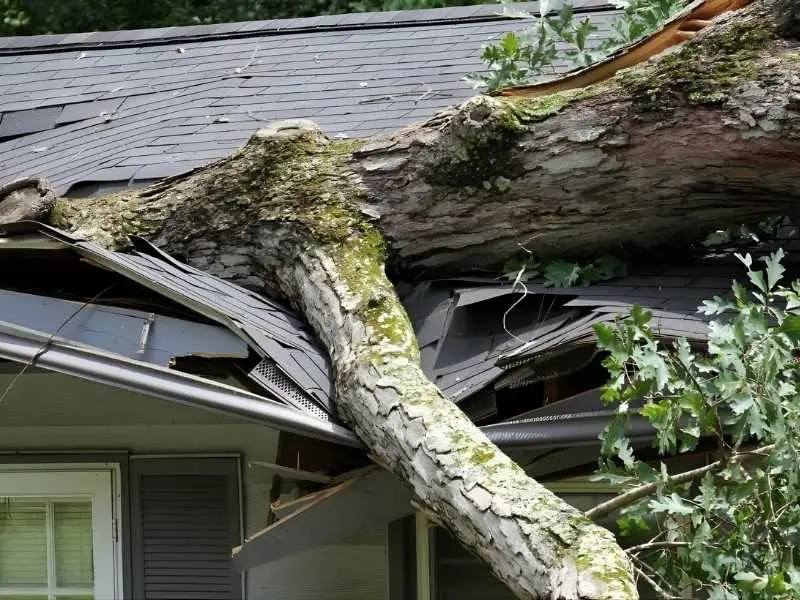
Different storm events create different damage patterns on commercial roofing systems, and correctly identifying the damage type before beginning restoration prevents misdiagnosed repairs that address the visible symptom while leaving the root cause unaddressed. Hail impact damage on commercial roofs is one of the most frequently underestimated damage types because its most serious consequences occur below the surface.
Hailstones that penetrate or dimple a commercial membrane compress the insulation board beneath, reducing its R-value and creating a moisture pathway even when the membrane surface appears visually intact after the storm. A professional post-hail inspection using a core cut or infrared scan is the only reliable way to assess hail-induced insulation damage on a commercial flat roof.
Wind uplift damage on commercial roofs begins at the perimeter, where the membrane is most vulnerable to edge lift, and progresses inward if wind loading exceeds the fastener or adhesive capacity holding the membrane to the substrate. Edge metal blow-off, membrane billowing at corners, and seam separation along the building perimeter are the visible indicators of wind uplift damage.
The invisible indicator is the number of fasteners or adhesive bonds across the field that have been stressed to or beyond their rated capacity without producing visible surface displacement. Wind uplift events that do not visibly damage the membrane surface can still reduce its wind resistance rating for subsequent events. Flashing failure at HVAC curbs, parapet walls, pipe penetrations, and expansion joints is the most common source of active post-storm water intrusion on commercial buildings.
Storm events with high wind speed and sustained rainfall force water through flashing gaps that would not leak under standard rain conditions, exposing inadequate sealant application or mechanical fastening that was never sufficient for storm-level exposure. Ponding water damage accelerates after storm events when drainage systems are overwhelmed or damaged by debris impact.
Commercial roofs accumulate debris from surrounding trees, signage, and rooftop equipment during high-wind events, and that debris frequently blocks drains and scuppers within hours of the storm passing. Water that ponds for more than 48 hours after a rain event accelerates membrane degradation, compresses insulation, and adds structural load to the deck that was not accounted for in the original building design.
Storm-driven debris impact creates punctures, abrasion damage, and membrane displacement across the roof field from objects carried by high winds from adjacent properties or from rooftop equipment and signage that becomes a projectile during the storm. Commercial roofs in urban and suburban environments are exposed to a wide range of airborne debris profiles during major storm events that are difficult to predict and that produce widely variable damage patterns across a single roof surface.
Roof Storm Damage Restoration: Step-by-Step Process
A properly executed commercial roof storm damage restoration follows a defined sequence that satisfies both the physical repair requirement and the insurance claim documentation requirement simultaneously.
Step 1: Deploy emergency stabilization within 24 hours of the storm. Install temporary protective tarping over any area of exposed membrane or deck, clear all roof drains and scuppers of storm debris, and apply temporary sealant at any active water entry point identified during the initial exterior walk. Emergency stabilization is a covered expense under most commercial property insurance policies and prevents the claim scope from expanding during the adjustment process.
Step 2: Document the full damage scope before any permanent repair begins. Engage a qualified commercial roofing contractor or independent roof consultant to perform a comprehensive post-storm inspection covering the full roof surface, all perimeter flashings, every rooftop penetration, all HVAC curbs and equipment bases, and the attic or plenum space below the deck. The inspection should produce a written report with date-stamped photographs of every damage location, core cut samples where insulation damage is suspected, and infrared scan results if moisture infiltration is present in the insulation layer.
Step 3: Notify the insurance carrier and open a commercial property claim. Provide the insurer with the storm date, a description of the damage, and the emergency stabilization measures taken. Request an adjuster inspection and confirm the claim number and the adjuster’s contact information. Retain all emergency stabilization receipts, as these expenses are typically recoverable under the claim.
Step 4: Obtain independent scope documentation before the adjuster inspection. A building owner who has a contractor’s written damage scope and photo documentation before the adjuster arrives is in a fundamentally stronger negotiating position than one who relies solely on the adjuster’s assessment. Insurance adjusters are not commercial roofing experts, and independent scope documentation ensures that all damage items are on the table during the settlement negotiation.
Step 5: Review the adjuster’s scope against the independent contractor assessment. Compare every line item in the adjuster’s estimate against the contractor’s damage scope. Items that appear in the contractor’s documentation but are absent from the adjuster’s scope should be formally disputed with supporting photo documentation before accepting any settlement offer.
Step 6: Select a licensed commercial roofing contractor and begin permanent restoration. Upon the settlement agreement, engage a licensed commercial roofing contractor with documented experience in the specific membrane system type on the building. Confirm that the contractor carries commercial general liability insurance, workers’ compensation coverage, and any manufacturer certification required for warranty issuance on the restored system.
Step 7: Obtain a post-restoration inspection and warranty documentation. Upon completion, request a formal post-restoration inspection report, manufacturer warranty documentation for any new membrane material installed, and a workmanship warranty from the installing contractor. These documents are the building owner’s protection against restoration work that fails prematurely and the foundation for the next storm damage claim if another event occurs.
Commercial Roof Restoration Timeline Reference
| Restoration Phase | Timeframe | Key Deliverable |
|---|---|---|
| Emergency stabilization | Within 24 hours of the storm | Tarping, drain clearing, and temporary sealing |
| Full damage documentation | Within 3 to 5 days | Written report with photos and core samples |
| Insurance claim filing | Within 7 days of the storm | Claim number and adjuster assignment |
| Adjuster inspection | 5 to 15 days after filing | Adjuster scope and initial settlement offer |
| Scope negotiation and agreement | 2 to 6 weeks after filing | Agreed settlement amount |
| Permanent restoration completion | 4 to 12 weeks after settlement | Restored system with warranty |
Common Commercial Storm Damage Restoration Mistakes to Avoid
Allowing permanent restoration work to begin before the insurance scope is agreed and documented is one of the most financially damaging mistakes a building owner can make in the restoration process. Work completed before the adjuster inspection eliminates the adjuster’s ability to assess the original damage condition, frequently resulting in a settlement that covers only a fraction of the actual restoration cost because the pre-repair evidence no longer exists.
Always complete documentation and adjuster inspection before authorizing any permanent repair work beyond emergency stabilization. Accepting the first adjuster scope without independent review consistently underfunds commercial roof storm restorations. Insurance adjusters in catastrophic storm markets are managing hundreds of concurrent claims and frequently apply scope templates that miss building-specific damage items, underestimate the cost of specialized membrane materials, and omit recoverable expenses like emergency stabilization, debris removal, and code upgrade requirements triggered by the restoration permit.
A public adjuster or attorney specializing in commercial property claims can recover scope and pricing corrections that routinely exceed their fees on large commercial restoration projects. Selecting a restoration contractor based on price alone in the post-storm market creates the highest concentration of quality risk in the entire restoration process. The commercial roofing market during a post-storm surge attracts contractors who are not certified for the specific membrane system on the building, who use non-matching materials that void the existing manufacturer’s warranty, and who prioritize volume over workmanship quality in a high-demand environment.
Verifying manufacturer certification, checking commercial references on comparable projects, and confirming licensing and insurance before selection produces a materially better outcome than price-based selection every time. Neglecting to include rooftop HVAC equipment, electrical penetrations, and mechanical curb flashings in the restoration scope leaves active water entry points around the most expensive components on the roof.
Every curb flashing, pipe boot, conduit penetration, and equipment base on a commercial roof is a potential storm damage location that should be inspected and included in the restoration scope rather than assumed to be undamaged because it was not the most visually obvious damage location on the roof surface. Failing to address underlying drainage problems identified during the restoration process while the roof is already open for work is a missed opportunity that guarantees the next storm event will create ponding water damage in the same locations the restoration was designed to resolve.
Commercial Storm Damage Restoration Benchmarks by Roof Age
Roof age determines the restoration options available and the insurance coverage implications for a commercial storm damage claim. Commercial roofs 0 to 5 years old sustaining storm damage are in the strongest position for full insurance-funded restoration. New systems carry full replacement value coverage in most commercial property policies with minimal depreciation deduction, and manufacturer warranties may also contribute to repair funding depending on the damage type and installation quality.
Between 5 and 10 years, commercial roofing systems are approaching the midpoint of most membrane warranties and are in a period where storm damage documentation must distinguish between storm-caused damage and normal service wear to maintain full claim value. An independent roof consultant engaged before the adjuster inspection helps ensure that legitimate storm damage is not reclassified as maintenance-deferred wear.
At 10 to 15 years, many commercial property insurance policies begin applying actual cash value adjustments to older membrane systems rather than paying full replacement cost. Building owners in this age range should review their policy terms specifically for roof age-related coverage limitations before a storm event occurs, rather than discovering them during the claim process. Between 15 and 20 years, storm damage restoration on a commercial roof of this age frequently triggers a conversation between the building owner, the insurance carrier, and the contractor about whether restoration or full replacement is the more appropriate response.
A roof approaching the end of its rated warranty life may not qualify for like-for-like restoration funding from the insurer. Over the past 20 years, most commercial roofing systems have exceeded their original warranty period and are subject to significant depreciation in insurance claim settlements regardless of their apparent physical condition. Because commercial roof storm damage restoration often requires full replacement for systems of this age, the building owner should budget for a gap between the depreciated insurance settlement and the actual replacement cost of a new code-compliant system.
Technology Tools Building Owners Can Use
Modern technology tools have transformed the speed, accuracy, and defensibility of commercial roof storm damage documentation and restoration management. Infrared thermography surveys conducted by certified thermographers identify moisture infiltration in commercial roof insulation layers within 24 to 48 hours of a storm event by detecting the temperature differential between wet and dry insulation as the roof surface cools after sunset, mapping the full extent of subsurface water damage before a single core cut is made.
Drone photogrammetry services produce georeferenced, high-resolution aerial imagery of the complete commercial roof surface within hours of a storm event, creating a timestamped visual damage record that covers every square foot of membrane, every perimeter edge, and every penetration point in a single flight.
Nuclear moisture scanning equipment provides non-destructive measurement of moisture content within the roof assembly at grid-point intervals across the full roof surface, quantifying the exact volume of saturated insulation that must be replaced rather than relying on visual inspection estimates that consistently understate the actual wet area.
Commercial property claim management software used by public adjusters and roofing consultants tracks every scope line item, photo reference, and settlement correspondence in a single organized file that prevents items from being lost or overlooked during multi-month negotiation processes.
Building information modeling platforms allow commercial roofing contractors to generate three-dimensional restoration plans from drone survey data, producing material quantity takeoffs and installation sequencing documents that reduce the estimation error and scope creep that add cost to commercial restoration projects.
DIY Assessment vs. Professional Restoration: Know the Difference
Building owners and property managers can safely perform a post-storm ground-level perimeter walk to observe visible membrane blow-off, edge metal displacement, and debris accumulation on the roof surface, check interior ceiling tiles and wall surfaces for water staining that indicates active infiltration, clear accessible roof drain covers of surface debris using a roof-safe tool from the drain access hatch if available, and document all observed damage with photos and videos from accessible vantage points before contacting a contractor or insurer.
However, every aspect of the actual commercial roof storm damage restoration process, including accessing the roof surface to assess damage, performing core cuts to evaluate insulation condition, applying temporary sealing at identified penetrations, removing and replacing membrane sections, reinstalling or replacing flashings at curbs and penetrations, and commissioning the restored system for warranty compliance, requires a licensed commercial roofing contractor with the appropriate manufacturer certification for the specific membrane system on the building.
Commercial roofing systems are engineered assemblies with specific installation requirements at every layer, and any restoration work performed by an uncertified contractor risks voiding manufacturer warranties and creating installation defects that will not be covered in a subsequent storm event.
Seek immediate professional attention and do not enter the building spaces below the roof if any part of the interior ceiling structure shows signs of active deflection or sagging following a storm event, if multiple roof drains are simultaneously blocked and water is visibly ponding at a depth of more than two inches across a large roof area, or if a rooftop HVAC unit or other heavy equipment has been displaced from its curb mounting by wind loading. These conditions present immediate structural and safety risks that require professional assessment before the building is occupied or accessed below the affected areas.
Final Thoughts
The gap between what an unprepared building owner recovers from a commercial storm damage claim and what a prepared one recovers is measured not in percentages but in multiples. Don’t leave your recovery to chance; get a free quote for your restoration today to maximize your insurance scope.
Emergency stabilization within 24 hours, independent damage documentation before the adjuster arrives, and contractor selection based on certification and references rather than price are the three decisions that determine whether a storm event becomes a fully funded restoration or a financially damaging combination of an inadequate settlement and substandard repair work. The storm does not care about the building’s age or the owner’s schedule. The preparation and response process is the only variable that matters once it has passed.
FAQs
1. What does commercial roof storm damage restoration include?
A: It covers full assessment, emergency stabilization, insurance documentation, membrane repair or replacement, flashing restoration, and post-restoration warranty issuance for the entire affected roof system.
2. How long does commercial roof storm damage restoration take?
A: Emergency stabilization happens within 24 hours. Full restoration typically completes 4 to 12 weeks after the insurance scope is agreed, depending on project size and material lead times.
3. Does commercial property insurance cover full roof restoration after a storm?
A: Usually, yes, for systems under 15 years old on replacement cost value policies. Older roofs may receive actual cash value settlements with depreciation deductions that leave a funding gap.
4: Should I hire a public adjuster for my commercial roof storm claim?
A: Yes, on any claim exceeding $25,000. Public adjusters consistently recover scope and pricing corrections that exceed their fees on large commercial restoration projects.
5: How do I know if my commercial roof has hail damage if it looks intact?
A: Visual inspection alone is unreliable. Infrared scanning and core sampling are the only reliable methods for detecting subsurface hail-induced insulation compression and membrane bruising.