Air curtain energy savings is a topic most homeowners and small business owners have never investigated, even though an unprotected open doorway can lose as much conditioned air in a single hour as an entire HVAC system produces all day. Air curtains are among the most consistently underestimated energy-efficiency investments for any building with a frequently opened exterior door, and the gap between what most people assume they cost and what they actually deliver in verified energy savings is significant enough to change the financial calculation for a major operational expense.
By understanding how air curtains work, where they deliver the strongest return, and how to select and size the right unit for a specific application, homeowners and building operators can make a decision grounded in real numbers rather than marketing claims. This guide covers everything you need to know about residential vs commercial roofs.
What is an Air Curtain and How Does it Produce Energy Savings? (The Simple Definition)
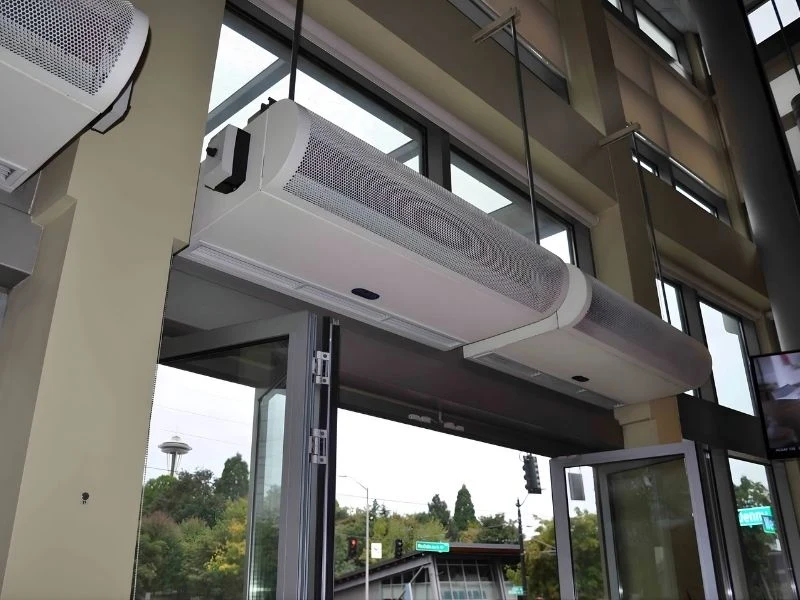
An air curtain is a mechanical device mounted above a doorway that projects a continuous, high-velocity stream of air downward across the opening, creating an invisible barrier that separates the conditioned interior environment from the unconditioned exterior without physically blocking the passage. When properly sized and positioned, this air stream intercepts the infiltration of outside air that would otherwise flood the interior every time the door opens or remains open for an extended period.
Air curtain energy cost savings are generated by reducing the volume of conditioned air lost through open doorways and the corresponding reduction in HVAC load required to compensate for that loss. In climates with significant temperature differentials between interior and exterior conditions, this load reduction translates directly into measurable reductions in heating and cooling energy consumption.
Air Curtain Energy Savings by Application Type
| Application | Door Open Time | Estimated Energy Savings | Payback Period |
|---|---|---|---|
| Retail store entrance | High traffic, frequently open | 30 to 50 percent of door infiltration loss | 1 to 3 years |
| Restaurant or food service entrance | Moderate to high traffic | 25 to 45 percent infiltration reduction | 1 to 4 years |
| Warehouse loading dock door | Extended open periods | 40 to 60 percent heating or cooling loss | 6 months to 2 years |
| Residential exterior door | Low to moderate traffic | 15 to 30 percent infiltration reduction | 3 to 7 years |
| Cold storage or refrigerated space | Continuous or frequent opening | 50 to 80 percent refrigeration load reduction | 6 months to 18 months |
| Industrial facility personnel door | Moderate traffic | 35 to 55 percent infiltration reduction | 1 to 3 years |
Cold storage and loading dock applications consistently deliver the fastest payback periods because the energy cost of replacing the roof, which loses conditioned air is highest when the temperature differential between inside and outside is greatest.
Why Air Curtain Energy Cost Savings Matter
The Annual Cost of Unprotected Open Doorways
| Building Type | Annual Infiltration Energy Cost Without Air Curtain | Annual Energy Cost With Air Curtain | Estimated Annual Savings |
|---|---|---|---|
| Small retail store (single entrance) | $1,800 to $4,500 | $900 to $2,500 | $900 to $2,000 |
| Restaurant (front entrance) | $2,500 to $6,000 | $1,400 to $3,500 | $1,100 to $2,500 |
| Warehouse loading dock (single door) | $4,000 to $12,000 | $1,500 to $5,000 | $2,500 to $7,000 |
| Cold storage walk-in (frequent access) | $6,000 to $18,000 | $1,200 to $4,000 | $4,800 to $14,000 |
| Residential exterior door (high traffic) | $400 to $1,200 | $280 to $840 | $120 to $360 |
These figures reflect the energy cost of replacing infiltrated air across a full calendar year of normal door use patterns. Buildings in climates with extreme summer heat or cold winters sit at the high end of these ranges because the HVAC system works harder to compensate for each cubic foot of infiltrated outside air.
The Secondary Savings That Most Calculations Miss
Air curtain energy savings extend beyond the direct HVAC load reduction that most energy audits measure. Reduced infiltration lowers indoor humidity fluctuations that cause moisture damage to inventory, flooring, and finishes. It reduces dust and airborne contaminant entry that shortens HVAC filter life and increases maintenance frequency.
In food service environments, it reduces insect infiltration that requires ongoing pest control expenditure. And in any retail environment, it maintains the consistent interior temperature that customers associate with comfort and that drives dwell time and purchase behavior. Each of these secondary effects carries a measurable financial value that adds to the return on air curtain investment.
Types of Air Curtains: Know Your Options First
Different building types, door dimensions, and climate conditions call for different air curtain configurations, and selecting the right type before purchasing determines whether the unit delivers its rated energy savings or underperforms in the specific application. Recirculating air curtains draw room air in through the back of the unit, accelerate it through a blower assembly, and project it across the doorway in a laminar sheet before allowing it to return to the room.
They do not introduce outside air into the building and are the most effective type for maintaining interior temperature and air quality in climate-controlled environments. Non-recirculating air curtains project room air across the opening without a return path, creating a pressure differential barrier that resists outside air infiltration. They are simpler and less expensive than recirculating models, but less effective in high-wind or extreme temperature differential applications.
Heated air curtains incorporate an electric or hydronic heating coil in the air stream, adding active heating capacity to the barrier effect. They are commonly used in northern climates where the primary energy challenge is winter heat loss through open doors and where the air stream itself must be warm enough to prevent cold penetration into the interior space at floor level. Unheated air curtains rely on air velocity alone to create the barrier effect without adding heat to the air stream.
They are effective in moderate climates and in applications where the temperature differential between inside and outside is less than 30 to 40 degrees Fahrenheit. Industrial high-velocity air curtains produce significantly higher air stream velocities than standard commercial models and are used in manufacturing, logistics, and cold storage applications where large door openings, long open periods, and extreme temperature differentials require maximum infiltration resistance.
Residential air curtains are scaled-down versions of commercial recirculating or non-recirculating units designed for standard residential exterior door dimensions. They deliver meaningful energy savings in high-traffic residential doorways but are sized and priced for the residential market rather than the commercial installation.
How to Size an Air Curtain for Maximum Energy Savings
Correct sizing is the single most important variable in air curtain energy savings performance. An undersized unit produces insufficient air velocity to maintain the barrier effect across the full door width, and an oversized unit wastes energy on air volume that the application does not require.
Rule 1: Match the air curtain width to the door width exactly. The air curtain should cover the full width of the door opening with no gap on either side. Most manufacturers produce units in standard widths of 36, 48, 60, 72, and 96 inches. Always select the unit width that matches or slightly exceeds the door width rather than falling short.
Rule 2: Match the air stream velocity to the door height. Taller doors require higher air velocity to maintain the barrier effect across the full height of the opening. A standard 7-foot door requires a minimum discharge velocity of approximately 600 to 800 feet per minute. A 10-foot door requires 900 to 1,200 feet per minute. An undersized unit on a tall door allows infiltration at the lower portion of the opening where velocity drops below the barrier threshold.
Rule 3: Account for ambient wind pressure at the installation location. Doorways exposed to prevailing wind require higher air curtain velocity to overcome the wind pressure pushing against the barrier. Locations sheltered from wind perform well at standard velocity ratings. Exposed locations, including corner doors, loading dock openings, and doorways in wind tunnel configurations between buildings, require units rated for high-wind applications.
Rule 4: Consider the temperature differential in your climate. Applications in climates where the inside-outside temperature differential regularly exceeds 40 degrees Fahrenheit should specify heated air curtain models or higher-velocity unheated models to maintain barrier effectiveness under extreme conditions.
Air Curtain Sizing Reference Chart
| Door Width | Door Height | Recommended Unit Width | Minimum Air Velocity | Suggested Model Type |
|---|---|---|---|---|
| 36 inches | Up to 7 feet | 36 inches | 600 FPM | Standard residential or commercial |
| 48 inches | Up to 8 feet | 48 inches | 700 FPM | Standard commercial |
| 60 inches | Up to 9 feet | 60 inches | 800 FPM | Commercial recirculating |
| 72 inches | Up to 10 feet | 72 inches | 900 FPM | Commercial or light industrial |
| 96 inches | Up to 12 feet | 96 inches | 1,100 FPM | Industrial high-velocity |
Common Air Curtain Saving Mistakes to Avoid
Installing an air curtain narrower than the door opening is the most common sizing error in air curtain installation and the one that most reliably produces disappointing energy savings. Even a 4-inch gap on one side of the door allows a continuous column of outside air to bypass the barrier entirely, reducing the unit’s effective infiltration resistance by a disproportionate amount relative to the size of the gap. Always size to the full door width without exception.
Mounting the air curtain too far above the door opening reduces the air stream velocity at the floor level below the threshold needed to maintain the barrier effect. Most manufacturers specify a maximum mounting height above the door header, typically 8 to 10 inches. Exceeding this distance requires a higher-velocity unit to compensate for the increased distance the air stream must travel before reaching floor level.
Installing an unheated air curtain in a climate where winter temperature differentials regularly exceed 40 degrees Fahrenheit produces a unit that maintains the air barrier adequately in moderate weather but allows cold penetration at floor level during peak winter conditions when the pressure differential across the door opening is highest. Specifying a heated model or a high-velocity unheated model for cold climate applications prevents this seasonal performance gap.
Assuming that any air curtain installation will deliver published energy savings without commissioning and adjustment after installation leaves performance on the table. Air curtain energy savings are optimized through post-installation airflow testing and adjustment of the discharge angle, which most manufacturers specify at 10 to 15 degrees outward from the building.
An uncalibrated unit can deliver 30 to 40 percent less energy savings than its rated performance. Neglecting filter maintenance on recirculating air curtains allows dust buildup on the intake grille and blower assembly, reducing air volume output over time and gradually degrading the unit’s barrier effectiveness and energy savings. Most manufacturers recommend filter inspection every 90 days in commercial environments.
Air Curtain Energy Save Performance Benchmarks Over Time
Air curtain energy savings performance shifts at predictable intervals, depending on maintenance practices, installation quality, and the evolution of the building’s door-use patterns. Units in their first 0 to 3 years of service are at their peak performance if correctly sized, installed, and commissioned.
The most common issue during this period is discharge-angle miscalibration from an installation that was not properly commissioned, which can be corrected with a service visit that costs less than one month of the missed energy savings. Between 3 and 7 years, blower motor bearings in high-cycle commercial applications begin to wear, reducing maximum air volume output.
Annual motor performance checks at this stage allow bearing replacement before the efficiency reduction becomes measurable in energy bills. Filter replacement frequency should be determined by actual dust accumulation rates in the specific application environment, rather than by the manufacturer’s generic recommendation.
At 7 to 12 years, recirculating air curtain units in high-traffic commercial applications may require blower motor replacement as bearing wear progresses to the point where air output has declined meaningfully from the original rated performance. Motor replacement at this stage is significantly less expensive than unit replacement and restores the original energy savings performance.
Between 12 and 20 years, control electronics in air curtain units, particularly in heated models with thermostat or building management system integration, may develop reliability issues that reduce the unit’s ability to respond correctly to door-opening and closing cycles. Units that run continuously when the door is closed waste more energy than the infiltration they would otherwise prevent, reversing the energy savings calculation.
Over the past 20 years, full unit replacement has been the most cost-effective path forward. Air curtain technology has advanced significantly over two decades, and a new unit installed in the same location will almost always deliver measurably higher energy savings at lower operating energy consumption than the aged unit it replaces.
Technology Tools That Maximize Air Energy Savings
Modern tools make air curtain performance verification, energy savings measurement, and system optimization more accessible than ever. Building energy monitoring systems with door-level sub-metering allow operators to measure the HVAC load reduction attributable to air curtain operation in real time by comparing energy consumption during periods when the air curtain is active versus inactive under similar temperature conditions.
Thermal imaging cameras used during an air curtain commissioning visit reveal the exact shape and coverage of the air barrier across the door opening, identifying gaps, angle misalignment, and velocity deficiencies that are invisible to a visual inspection but that represent measurable energy losses.
Door open time sensors connected to building management systems provide data on actual door open duration per hour and per day, which is the primary variable driving infiltration energy cost and the most important input for calculating accurate air curtain payback periods in specific applications.
Smart air curtain controllers available from major manufacturers activate the unit automatically when the door opens and shut it down when the door closes, eliminating the energy waste of continuous operation during closed-door periods and delivering meaningful additional energy savings beyond the infiltration reduction alone.
Air infiltration testing using a blower door apparatus, typically performed by a certified energy auditor, quantifies the exact volume of outside air entering through a specific doorway before and after air curtain installation, providing verified energy savings data that supports equipment investment decisions and utility rebate applications.
DIY Installation vs. Professional Installation: Know the Difference
Homeowners and small business operators can safely handle residential air curtain installation on standard single door openings where the unit mounts above the door frame on a surface that can support the unit’s weight, the electrical connection matches the unit’s power requirement, and the installation follows the manufacturer’s mounting template without modification.
Most residential and light commercial air curtain units are designed for DIY installation with standard hardware and a basic understanding of electrical connections at a standard outlet or hardwired junction box.
However, industrial high-velocity unit installation, three-phase electrical connections, units requiring building management system integration, hydronic heated models requiring plumbing connections, and any installation on a door opening wider than 72 inches or taller than 10 feet should be performed by a licensed contractor with air curtain installation experience.
Improper mounting of a large commercial unit creates structural loading risks at the door header, and incorrect discharge angle calibration on an industrial unit can create excessive air pressure in the interior space that interferes with door operation and creates discomfort for occupants near the entrance.
Seek professional commissioning assistance if energy bills do not show a measurable reduction within the first two billing cycles after air curtain installation, if the unit runs continuously without cycling off when the door is closed, or if condensation or frost forms at the lower portion of the door opening during winter operation. These are indicators that the unit is miscalibrated, undersized, or incorrectly specified for the application and that a professional assessment will identify the specific correction needed.
Final Thoughts
Air curtain energy savings are real, measurable, and consistently underestimated by the homeowners and building operators who would benefit most from them. The calculation is straightforward: the energy cost of an unprotected open doorway is far higher than most people assume, the cost of the device that addresses it is lower than most people expect, and the payback period in any high-traffic or temperature-sensitive application makes the investment difficult to argue against on financial grounds alone.
Size it correctly, install it at the right height, commission the discharge angle properly, and maintain the filter on schedule. This four-step discipline is the difference between an air curtain that pays for itself in two years and one that underperforms; click here to get a free quote and ensure your system is optimized for maximum savings.
FAQs
1. What is an air curtain, and how does it save energy?
A: It projects a high-velocity air stream across an open doorway, blocking outside air infiltration and reducing the HVAC load needed to compensate for lost conditioned air.
2. How much energy can an air curtain actually save?
A: Depending on application and climate, air curtains reduce door infiltration energy loss by 25 to 80 percent. Cold storage and loading dock applications deliver the highest savings.
3. How long does it take for an air curtain to pay for itself?
A: Residential applications typically pay back in 3 to 7 years. Commercial and industrial applications with high door traffic pay back in 6 months to 3 years.
4: Does an air curtain need to be heated to save energy in cold climates?
A: Yes. In climates where indoor-outdoor temperature differentials regularly exceed 40 degrees Fahrenheit, a heated model is required to maintain effective barrier performance in winter.
5: How do I know if my air curtain is actually working correctly?
A: Monitor energy bills for a measurable reduction within two billing cycles. If savings are absent, have the discharge angle and air velocity professionally calibrated.