What does hail damage look like on a roof is the question most homeowners ask, standing in their driveway the morning after a storm, staring up at their shingles and genuinely unsure whether what they are seeing is serious damage, normal aging, or nothing at all. Hail damage is the single leading cause of homeowners’ insurance claims in the United States, yet it is also the most frequently misidentified and most often missed damage type in residential roofing because its most consequential effects are subtle, progressive, and invisible from the ground without knowing exactly what to look for.
Understanding what hail damage actually looks like on every roofing material, how it differs from normal wear, and what indicators on the ground and in the gutters confirm a storm event occurred gives homeowners the knowledge to act correctly before the claim window closes. This guide covers everything you need to know.
What Does Hail Damage Look Like on a Roof? (The Simple Definition)
Hail damage on a roof is the physical degradation caused by hailstone impact on roofing materials, ranging from cosmetic surface marks that do not immediately compromise waterproofing to functional damage that breaks the weather seal of the roofing system and creates an active pathway for water infiltration. The severity of hail damage depends on three variables: hailstone size, hailstone density and hardness, and the age and condition of the roofing material at the time of impact.
Not all hail damage is the same, and not all of it is immediately visible. The most financially consequential hail damage on a residential roof is the kind that looks minor on the surface but has fractured the structural layer of the shingle beneath, setting up a progressive failure that produces active leaks months or years after the storm event.
Hail Size and Expected Roof Damage Reference
| Hail Size | Common Comparison | Expected Shingle Damage | Claim Worthiness |
|---|---|---|---|
| Under 1 inch | Marble size | Granule displacement only, cosmetic on new roofs | Low unless roof is aged |
| 1 to 1.25 inches | Quarter size | Measurable granule loss, sealant strip weakening | Moderate, inspect thoroughly |
| 1.5 inches | Half dollar size | Bruising, granule loss, potential mat fracture | High, professional inspection warranted |
| 1.75 inches | Golf ball size | Through-cracking on aged shingles, metal denting | Very High, file claim promptly |
| 2 inches and above | Egg size or larger | Punctures, splits, structural damage to deck components | Immediate claim, emergency inspection |
Hail at or above 1.5 inches in diameter on a roof older than 7 to 10 years is almost universally a claim-worthy event regardless of how the surface appears from the ground.
Why Knowing What Hail Damage Looks Like Matters (The Real Cost Breakdown)
The Financial Gap Between Identified and Missed Hail Damage
| Scenario | Identified and Claimed | Missed and Unclaimed | Financial Exposure |
|---|---|---|---|
| Functional shingle damage (moderate hail) | $8,000 to $18,000 covered claim | $0 recovery, full out-of-pocket replacement | Up to $18,000 loss |
| Metal flashing and gutter damage | $2,000 to $5,000 covered claim | Corrosion and failure within 2 to 3 years | $3,000 to $8,000 repair |
| Bruised shingles causing premature failure | $10,000 to $20,000 replacement funded | Undocumented, claim filed past one-year window | Full replacement cost uninsured |
| Skylight seal damage from hail | $800 to $2,500 covered claim | Active leak causing interior damage | $3,000 to $12,000 remediation |
| Ridge cap blow-off during same storm | $1,500 to $4,000 covered claim | Water entry at the ridge until the next inspection | $4,000 to $15,000 interior damage |
Texas law gives homeowners one year from the storm date to file a wind and hail claim. Homeowners who cannot identify hail damage when it occurs consistently miss this window and fund roof replacement entirely out of pocket on a system that a correctly filed claim would have covered.
Why Hail Damage Is So Frequently Missed
Insurance industry data consistently shows that a significant percentage of roofs sustaining functional hail damage in any given storm event are never inspected and never claimed. The primary reason is that most hail damage is not visible from the ground, does not produce immediate leaks, and looks to an untrained eye like nothing more than a dirty or slightly worn roof surface. By the time the damage becomes undeniable through active interior leaks, the one-year claim-filing window has often passed, and the progressive damage has compounded far beyond the original storm impact scope.
What Hail Damage Looks Like on Different Roofing Materials
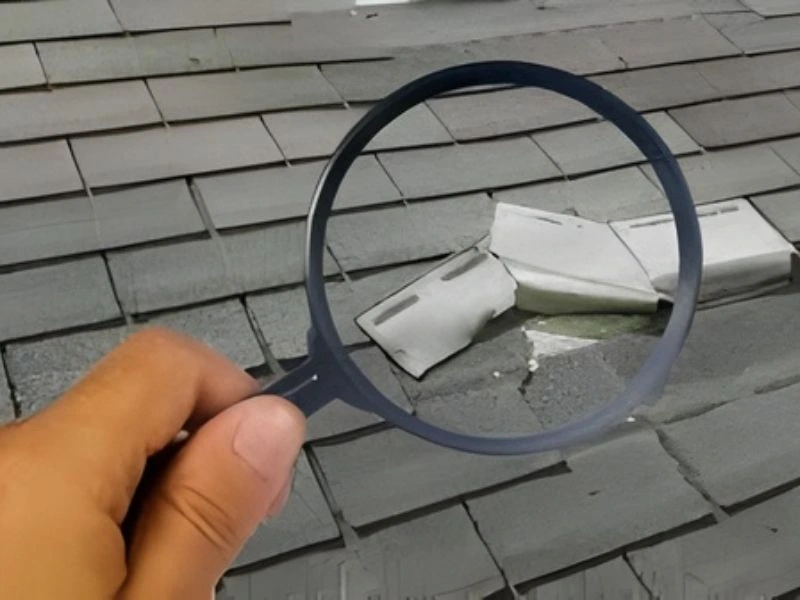
What does hail damage look like on a roof presents differently on every roofing material type, and recognizing the specific indicators for the material on your roof is the most practical skill a homeowner can develop for post-storm assessment. On asphalt shingles, hail damage appears as circular or roughly round impact marks where granules have been knocked loose from the shingle surface, leaving a darker, shinier exposed area of the underlying fiberglass mat or organic base.
Fresh hail impacts have a distinct black or dark gray appearance at the center of the impact zone that weathers to a lighter color over weeks and months. The impact mark itself may feel soft or spongy when pressed with a thumb, indicating that the shingle mat beneath the surface has been fractured or compressed.
On architectural or dimensional shingles, the layered construction makes hail damage slightly harder to identify because the irregular surface texture can obscure impact marks that would be immediately obvious on a flat 3-tab shingle. Look for areas where the granule surface has been disrupted in a pattern that does not follow the natural texture lines of the shingle, and for soft spots that persist under thumb pressure after the shingle has had time to dry completely.
On wood shake roofs, hail damage produces split marks along the grain of the shake, with fresh impact splits showing lighter wood color at the split edges compared to the weathered gray of the surrounding material. Hail impacts on wood shake create entry points for moisture that accelerate rot and fungal growth at the split location. On metal roofing panels and standing seam systems, hail creates visible dents or dimples in the panel surface that are most obvious in low-angle raking light.
The denting itself does not compromise the waterproofing of a properly installed metal system in most cases, but it is physical evidence of hail occurrence that supports damage claims on adjacent materials. On tile roofing, whether clay or concrete, hail damage appears as hairline cracks, chips at tile edges, or complete tile fractures on larger hail impacts. Cracked tiles are a direct water infiltration pathway because the mortar or underlayment below is exposed at the fracture point.
On flat roof membrane systems, including TPO and EPDM, hail damage ranges from surface scuffing and granule displacement on modified bitumen cap sheets to dimpling of single-ply membranes that compress the insulation board beneath, reducing its R-value and creating subsurface moisture pathways that are not visible at the surface.
What Hail Damage Looks Like: Ground-Level and Secondary Indicators
Some of the most reliable hail damage indicators are not on the roof surface itself but on the surrounding components and surfaces that are easier to observe from the ground or during a gutter cleaning.
Granules in the gutters and downspout discharge. After a hail event, gutters fill with the ceramic granules that coat the surface of asphalt shingles. A cup or more of granules in each gutter section after a storm is a strong indicator of meaningful granule displacement across the shingle field above. Fresh granules are uniformly colored and angular. Granules that have been in the gutter for months or years from normal wear are rounded and mixed with organic debris.
Dents on soft metal components. HVAC condenser fins, aluminum gutter sections, downspouts, roof vent covers, metal chimney caps, and window screen frames all dent visibly from hail impact. These components are the most accessible and most reliable physical evidence of hail occurrence and hail size because they respond predictably to impact. A homeowner who finds uniform denting patterns on soft metal components around the home has physical proof of a qualifying hail event at that specific address.
Damaged window screens and wood trim. Hail large enough to damage roofing materials typically leaves impact marks on painted wood surfaces like window trim, fascia boards, and deck railings, and punches holes or tears in aluminum or fiberglass window screens. These marks are at eye level and immediately visible during a post-storm walkthrough without any ladder or roof access.
Dents on vehicles parked outside during the storm. Vehicle hail damage is the most immediately obvious and most photographed evidence of a significant hail event, and its presence confirms hail occurrence and approximate size at the property location in a way that is difficult to dispute.
Hail Damage Indicators by Location
| Location | What to Look For | Access Required | Claim Value |
|---|---|---|---|
| Gutters and downspouts | Granule accumulation, denting on aluminum sections | Ground level | High |
| HVAC condenser unit | Fin denting pattern, uniform impact marks | Ground level | High |
| Window screens | Punctures, tears, and impact marks | Ground level | High |
| Roof vents and caps | Denting, displacement | Ground level or binoculars | High |
| Fascia and wood trim | Impact marks, paint chips | Ground level | Moderate |
| Shingle surface | Granule loss circles, soft spots, splits | Roof access required | Highest |
| Flashing metal | Denting, displacement at edges | Roof access required | High |
Common Hail Damage Identification Mistakes to Avoid
Confusing normal shingle aging with hail damage is the most common identification error homeowners make, and it cuts both ways. Homeowners who file claims for granule loss caused by normal weathering rather than a storm event create claim history that raises premiums without producing coverage.
Homeowners who dismiss genuine hail damage as normal aging miss legitimate claims. Normal granule loss appears gradually and uniformly across the full roof surface as shingles age. Hail impact granule loss appears as discrete circular marks concentrated in random patterns across the slope, often with a higher density on the side of the roof facing the storm direction.
Inspecting only the most visible slope of the roof from the ground and concluding the full roof is undamaged is an assessment shortcut that misses the damage patterns that hail creates. Hail damage density varies by roof slope direction relative to the storm track. The slope facing the prevailing storm direction typically sustains the highest impact density, while the opposite slope may show less damage. Both slopes must be assessed before a damage conclusion is drawn.
Assuming that a roof with no visible leaks has no hail damage is the most financially costly identification error a homeowner can make. Hail damage does not produce immediate leaks in most cases. It fractures the shingle mat, accelerates UV degradation of the exposed fiberglass, and creates a vulnerability that produces active leaks months to years after the impact event, long after the claim window has closed.
Relying on a single photo taken from the ground as the basis for a damage assessment provides no useful information about whether functional hail damage exists. Ground-level photos of an asphalt shingle roof after a hail storm cannot capture the granule displacement patterns, soft spots, and mat fractures that constitute functional damage. A hands-on professional inspection that includes palpation testing of the shingle surface is the minimum standard for a credible post-hail damage assessment.
Dismissing dents on gutters and HVAC equipment as cosmetic and unrelated to roof damage eliminates the most accessible physical evidence of hail occurrence at the property. Denting patterns on soft metal components confirm hail size and density in a way that supports the full claim scope, not just the gutter replacement line item.
Hail Damage Progression Benchmarks by Roof Age
The appearance and severity of hail damage on a residential roof change significantly depending on the roof’s age at the time of impact. Roofs 0 to 5 years old struck by hail of 1.5 inches or larger will show the granule displacement and mat bruising described above, but the shingle mat is flexible enough in new material to absorb moderate impacts without fracturing. Functional hail damage on a new roof from a single event typically requires hail of 1.75 inches or larger to produce through-damage that compromises waterproofing immediately.
The claim value on a new roof is highest because replacement cost value coverage with minimal depreciation applies. Between 5 and 10 years, UV exposure and thermal cycling have reduced shingle flexibility and granule adhesion to the point where a 1.5-inch hail event begins to produce functional mat damage rather than purely cosmetic granule displacement. Inspections after hail events in this age range should include hands-on palpation testing rather than visual-only assessment.
At 10 to 15 years, shingles are in the window of highest cumulative hail vulnerability. Granule coverage has typically declined from its original density, the mat has hardened from years of UV exposure, and previous moderate hail events may have created subsurface fractures that were never large enough to claim independently but that have collectively weakened the shingle structure. A 1-inch hail event on a 12-year-old roof can produce functional damage that the same storm would not cause on a 5-year-old roof.
Between 15 and 20 years, hail damage on roofs in this age range is almost always functional rather than cosmetic because the shingle material has degraded to the point where any meaningful hail impact fractures the mat rather than simply displacing granules. Post-hail inspections on roofs of this age consistently produce replacement recommendations rather than repair scopes. Over the past 20 years, a hail event of any meaningful size on a standard asphalt shingle roof is almost universally a replacement-triggering event.
The combination of aged materials, accumulated prior impact history, and reduced granule coverage means that functional damage is present across a far greater percentage of the roof surface than on a younger system exposed to the same storm.

Technology Tools Homeowners Can Use
Modern tools give homeowners far more capability to identify and document hail damage than was available even five years ago. Hail history lookup services allow homeowners to enter their property address and retrieve a verified record of hail events at that specific location, including date, storm path, and maximum hail size, confirming whether a qualifying event occurred before scheduling an inspection or filing a claim.
Smartphone camera zoom and video capabilities allow homeowners to document visible damage indicators at the gutter level, on HVAC equipment, and on soft metal components from ground level immediately after a storm, creating a timestamped record of secondary damage indicators that support the roofing claim independently.
Drone inspection services deployed by licensed San Antonio and nationwide roofing contractors provide high-resolution aerial imagery of the full roof surface within 24 to 48 hours of a storm event, identifying granule displacement patterns, impact mark locations, and metal component denting across the complete roof surface without requiring the homeowner to access the roof.
Thermal imaging cameras detect subsurface moisture infiltration through bruised or fractured shingles that have not yet produced a visible interior stain, identifying functional damage locations that a visual inspection cannot find. Roofing inspection apps available from several major manufacturers and insurance platforms allow homeowners to log inspection findings, attach photos with GPS coordinates, and generate a preliminary damage report that organizes the documentation before a professional inspection is scheduled.
DIY Damage Assessment vs. Professional Inspection: Know the Difference
Homeowners can safely perform a comprehensive ground-level secondary indicator assessment after any suspected hail event. Checking gutters for granule accumulation, photographing dents on HVAC condenser fins and aluminum gutter sections, documenting window screen damage, checking wood trim and fascia for impact marks, and recording the storm date and hail size from a verified weather service are all ground-level tasks that require no roofing expertise and no ladder access and that create valuable supporting documentation for a professional inspection and insurance claim.
However, accessing the roof surface to assess shingle condition by palpation, inspecting flashing at chimney and vent penetrations, evaluating ridge cap adhesion and fastener condition, and performing the hands-on assessment that constitutes a credible post-hail damage inspection all require a licensed roofing contractor with appropriate fall protection equipment. DIY roof walking after a hail event is particularly hazardous because freshly impacted shingles can be slippery from dislodged granules, and hail damage to the deck or underlayment at specific locations creates soft spots that are not visible from above.
Seek immediate professional attention if gutter accumulation after a storm includes significant volumes of granules combined with shingle material fragments, if any ridge cap shingles are visible on the ground or in the yard following the storm, or if interior ceiling staining appears within days of a hail event rather than weeks or months later. These are indicators of severe functional damage that warrant an emergency inspection and same-day claim filing rather than a scheduled professional visit.
Final Thoughts
Knowing what does hail damage look like on a roof is a skill that pays for itself the first time a qualifying storm passes over a home, and the homeowner who has it files a fully documented claim while the neighbor who does not waits too long and loses the window. The secondary indicators at ground level are accessible to every homeowner within an hour of any storm.
The professional inspection that confirms functional damage and builds the claim scope costs a few hundred dollars or nothing when the contractor absorbs it as a free service. The combination of those two steps, performed promptly after every significant hail event, is the complete formula for protecting one of the largest single investments most families will ever make. Click here to get your free inspection today and secure your home’s future
FAQs
1. What does hail damage look like on asphalt shingles?
A: Circular dark marks where granules were knocked off, exposing the shingle mat. Fresh impacts feel soft or spongy when pressed with a thumb.
2. Can I see hail damage from the ground?
A: Not reliably on the shingle surface. Check gutters for granules and HVAC fins for denting. These ground-level indicators confirm hail occurred without roof access.
3. How do I know if my roof has functional hail damage or just cosmetic marks?
A: Functional damage fractures the shingle mat and feels soft under thumb pressure. Only a hands-on professional inspection can reliably distinguish functional from cosmetic damage.
4: How long after a hail storm do I have to file an insurance claim?
A: In Texas, one year from the storm date. In most other states, one to two years. File promptly after any confirmed hail event, regardless of visible damage severity.
5: Does hail damage always cause immediate roof leaks?
A: No. Most hail damage produces leaks months to years after the storm as the fractured mat deteriorates. By then, the claim window may have closed.