Commercial roof inspection cost is a number that most building owners and property managers either overestimate to the point of delaying inspections they should be scheduling annually, or underestimate by assuming the cheapest option available delivers the same value as a comprehensive professional assessment. Both assumptions are expensive. A commercial roof that goes uninspected accumulates damage across multiple seasons that compounds silently until a single storm or wet period converts a manageable repair into a full replacement project.
Understanding what commercial roof inspections actually cost, what drives the price difference between a basic walkthrough and a fully documented assessment, and how to match the right inspection type to the right situation allows building owners to spend inspection dollars in a way that protects the far larger investment sitting above their heads. This guide covers everything you need to know.
What is a Commercial Roof Inspection and What Does it Cost? (The Simple Definition)
A commercial roof inspection is a systematic professional assessment of every component of a commercial roofing system, including the membrane surface, flashings, penetrations, drainage components, rooftop equipment curbs, perimeter edge details, and the structural deck condition where accessible, performed by a qualified roofing professional to document current condition, identify deficiencies, and recommend repair or maintenance actions.
Commercial roof inspection cost varies significantly based on building size, roof system type, inspection method, inspector credentials, and the level of documentation required. The range runs from as little as $200 for a basic visual walkthrough on a small building to over $5,000 for a comprehensive infrared and core-sample inspection on a large complex roof with multiple membrane systems.
Commercial Roof Inspection Types and Cost Ranges
| Inspection Type | What It Includes | Typical Cost Range | Best Used For |
|---|---|---|---|
| Basic visual inspection | Surface walkthrough, photo documentation | $200 to $600 | Routine annual maintenance check |
| Standard professional inspection | Full surface, flashings, penetrations, written report | $400 to $1,200 | Pre-storm season, lease renewals |
| Infrared thermography scan | Moisture mapping beneath the membrane surface | $500 to $2,500 | Post-storm, suspected subsurface damage |
| Core sample inspection | Physical deck and insulation sampling at multiple points | $600 to $1,800 | Pre-purchase, insurance disputes |
| Comprehensive assessment | Infrared, core samples, full written scope report | $1,500 to $5,000 | Acquisition due diligence, major claims |
| Drone photogrammetry inspection | Aerial imagery and surface mapping | $400 to $1,500 | Large or unsafe-to-walk roofs |
| Manufacturer warranty inspection | Certification of compliance with warranty terms | $300 to $900 | Warranty renewal, coverage disputes |
The inspection type that is right for a specific situation depends on why the inspection is being performed, what decisions will be made based on its findings, and how much documentation is needed to support those decisions.
Why Commercial Roof Inspect Cost Matters (The Real Cost Breakdown)
What Skipping or Underfunding an Inspection Actually Costs
| Skipped Inspection Scenario | Missed Finding Cost | Full Inspection Cost | Net Loss |
|---|---|---|---|
| Annual inspection skipped, membrane seam failure undetected | $8,000 to $25,000 interior and deck damage | $400 to $800 | Up to $24,200 net loss |
| Pre-purchase inspection waived, insulation moisture found after closing | $15,000 to $60,000 remediation and replacement | $1,500 to $3,000 | Up to $57,000 net loss |
| Post-storm visual only, subsurface hail damage missed | $20,000 to $80,000 missed insurance claim value | $500 to $2,500 infrared scan | Up to $77,500 net loss |
| Warranty inspection skipped, coverage voided at claim | Full replacement cost uninsured | $300 to $900 | Full replacement exposure |
| Drain inspection omitted, ponding causes deck damage | $10,000 to $40,000 structural deck repair | Included in standard inspection | Full preventable loss |
The pattern across every row in this table is the same. The inspection cost is a small fraction of the damage cost it prevents or the claim value it protects. Commercial roof inspection is not a maintenance expense. It is a risk management investment with a calculable and consistently favorable return.
The Deferred Inspection Compounding Effect
A commercial roof that goes uninspected for three to five years does not accumulate three to five years of normal wear in a linear progression. Undetected membrane seam failures allow water to migrate laterally through the insulation layer, saturating areas ten to twenty times larger than the original entry point. Each wet season without intervention expands the affected area, increases the insulation replacement scope, and moves the deck closer to structural repair territory.
A $500 inspection performed annually for five years costs $2,500 total. The same roof, uninspected for five years with one undetected seam failure, can require $40,000 to $80,000 in insulation replacement and deck repair. The mathematics of deferred inspection is not ambiguous.
Factors That Drive Commercial Roof Inspection: Know What You Are Paying For
Different variables push commercial roof inspection costs down, and understanding each one allows building owners to evaluate quotes accurately and avoid paying for services that do not match the inspection need. Building size is the most straightforward cost driver. Inspection pricing is typically calculated on a per-square-foot basis for the roof area, with rates ranging from $0.02 to $0.10 per square foot depending on inspection type and roof complexity.
A 10,000 square foot roof at $0.05 per square foot produces a $500 baseline inspection fee before any specialized services are added. Roof system complexity increases inspection time and, therefore, cost. A simple single-ply TPO membrane on a flat rectangular building inspects faster than a built-up roof system with multiple penetrations, expansion joints, parapet walls, rooftop mechanical equipment, and varying membrane ages across different sections of the same roof.
Complex roofs with multiple system types, multiple drainage elevations, or significant rooftop equipment density cost more to inspect thoroughly and should be budgeted accordingly. Inspector credentials and certification level affect both inspection cost and inspection quality. A journeyman roofing technician performing a basic visual walkthrough charges less than a Registered Roof Consultant credentialed through the Roof Consultants Institute or a manufacturer-certified inspector whose findings carry warranty weight.
The credential level required depends on what the inspection findings will be used for. Geographic location influences commercial roof inspection cost through regional labor rates, travel costs for inspectors covering rural or suburban markets, and the competitive density of qualified commercial roofing professionals in the local market.
Major metropolitan markets with multiple competing inspection firms typically offer more competitive pricing than smaller markets where fewer qualified options exist. Documentation requirements drive cost meaningfully above the base inspection fee. A verbal report at the end of a walkthrough costs the least.
A written report with photo documentation, condition ratings by component, prioritized repair recommendations, and cost estimates costs more. A fully formatted inspection report suitable for lender submission, insurance claim support, or property sale disclosure costs the most and requires the most inspector time to produce.
Commercial Roof Inspection by Building Size and Type
Understanding the typical inspection cost for different commercial building profiles helps building owners budget accurately and evaluate contractor quotes against a realistic market baseline.
Small commercial buildings under 5,000 square feet, including retail storefronts, small office suites, and light industrial spaces typically pay $200 to $600 for a standard professional inspection with a written report. Infrared scanning on a building this size adds $300 to $600 to the base cost.
Mid-size commercial buildings between 5,000 and 25,000 square feet, including restaurants, medical offices, single-story retail, and small warehouses, typically pay $500 to $1,500 for a standard professional inspection. Infrared scanning adds $500 to $1,500, depending on roof complexity and scanning coverage requirements.
Large commercial buildings between 25,000 and 100,000 square feet, including big box retail, multi-tenant commercial, and medium industrial facilities, typically pay $1,000 to $3,500 for a comprehensive professional inspection. Infrared scanning at this scale adds $1,000 to $3,000, and drone photogrammetry adds $600 to $1,500.
Large industrial and warehouse facilities over 100,000 square feet, including distribution centers, manufacturing plants, and large commercial complexes, typically pay $2,500 to $6,000 for a full assessment, including infrared scanning, core samples, and a comprehensive written scope report suitable for capital planning or insurance claim support.
Commercial Roof Inspection Cost Reference by Building Profile
| Building Type | Roof Area | Standard Inspection | With Infrared Scan | Comprehensive Assessment |
|---|---|---|---|---|
| Small retail or office | 2,000 to 5,000 sq ft | $200 to $600 | $500 to $1,200 | $900 to $2,000 |
| Restaurant or medical office | 3,000 to 8,000 sq ft | $300 to $800 | $700 to $1,500 | $1,200 to $2,800 |
| Single-story retail or light industrial | 8,000 to 25,000 sq ft | $500 to $1,200 | $1,000 to $2,500 | $2,000 to $4,500 |
| Warehouse or distribution | 25,000 to 100,000 sq ft | $1,000 to $2,500 | $2,000 to $5,000 | $3,500 to $8,000 |
| Large industrial or campus | Over 100,000 sq ft | $2,000 to $5,000 | $4,000 to $10,000 | $6,000 to $15,000 |
Common Commercial Roof Inspection Mistakes to Avoid
Selecting the lowest-cost inspector without verifying credentials or inspection scope is the most common commercial roof inspection mistake building owners make, and it is the mistake that most reliably produces an inspection that fails to identify the conditions it was commissioned to find. A $200 basic walkthrough performed by an unqualified technician on a 20,000 square foot built-up roof with multiple membrane ages and suspected subsurface moisture produces documentation that is worth less than the paper it is printed on in an insurance claim or property transaction context.
Matching the inspection type and inspector credential to the specific purpose of the inspection protects the value of the investment. Commissioning a visual-only inspection after a significant hail event and accepting a clean report as confirmation that no insurance claim is warranted is a mistake that leaves millions of dollars in legitimate commercial hail damage claims unfiled every year in active hail markets. Visual inspection cannot detect hail-induced insulation compression or membrane bruising that has not yet produced a visible surface indentation.
Any commercial roof inspection performed after a confirmed hail event at the property should include infrared scanning or core sampling to assess subsurface damage before a claim decision is made. Scheduling commercial roof inspections reactively, only after visible damage or active leaks are reported, eliminates the early detection function that makes regular inspection cost-effective. By the time a building tenant or facilities manager reports a ceiling stain, the underlying damage has already progressed through multiple wet cycles. Annual proactive inspections on a defined schedule cost a predictable amount and prevent the unpredictable large repair costs that reactive inspections trigger.
Failing to retain inspection reports as part of the building’s permanent maintenance record eliminates the baseline documentation that makes subsequent inspections meaningful, and that supports insurance claims, property sales, and capital planning. An inspection report without the prior year’s inspection for comparison provides a snapshot of the current condition, but cannot identify the rate of deterioration or document that a specific damage condition is new rather than pre-existing.
Assuming that the inspection performed by a contractor bidding on repair work is equivalent to an independent third-party inspection creates a conflict of interest that produces inflated damage findings and repair scopes in some cases and minimized findings that protect a preferred repair approach in others. Independent inspections performed by parties with no financial interest in the repair outcome consistently produce more accurate and more defensible condition assessments than contractor-performed inspections on work that the same contractor intends to bid.
Commercial Roof Inspection Benchmarks by Roof Age
Roof age shapes both the frequency of inspection needed and the complexity and cost of the inspection appropriate for each stage of the roof system’s life. Commercial roofs 0 to 5 years old require annual inspections focused primarily on confirming that installation quality meets the manufacturer’s warranty requirements and that no early membrane seam failures, flashing deficiencies, or drainage issues have developed in the installation period. These inspections are straightforward and typically fall at the lower end of the cost range for the building size because the damage scope on a new system is limited.
Between 5 and 10 years, commercial roofing systems are approaching the midpoint of most standard membrane warranties and are in a period where the cost of proactive commercial roof inspection cost is the highest value relative to long-term repair savings. Membrane seams that were installed correctly but are beginning to show thermal cycling fatigue, and flashing sealants approaching the end of their service life, are all detectable and correctable at this age before they become active failure events.
Between 15 and 20 years, commercial roofing systems are approaching or exceeding the warranty period for most standard membrane products, and the inspection at this stage should specifically assess whether the system has remaining useful life that justifies continued maintenance investment or whether a replacement capital plan should be initiated. A comprehensive assessment, including core sampling and infrared scanning at this age, provides the documentation needed to make that decision on evidence rather than assumption.
Over the past 20 years, a comprehensive inspection has been essential before any significant repair investment is made. A building owner who invests $15,000 in membrane repairs on a 22-year-old roof without a comprehensive inspection confirming that the deck and insulation are sound may be applying repair dollars to a system that requires full replacement within the same budget cycle.
Technology Tools That Affect Commercial Roof Inspection and Value
Modern technology tools change both the cost structure and the value delivered by commercial roof inspections in ways that building owners should understand before selecting an inspection approach. Infrared thermography conducted by a certified thermographer is the single highest-value technology addition to a standard commercial roof inspection because it identifies subsurface moisture infiltration that no visual inspection can detect, mapping the full extent of wet insulation beneath an intact-appearing membrane surface.
The cost addition of $500 to $2,500, depending on roof size, is consistently justified when subsurface moisture is found because it quantifies the exact replacement scope rather than leaving it to post-repair discovery. Drone photogrammetry produces georeferenced aerial imagery of the complete roof surface at resolution levels that allow individual membrane seams, fastener patterns, and flashing details to be examined in the inspection report without the inspector physically accessing every point on the roof.
For large roofs, unsafe-to-walk surfaces, or roofs with extensive rooftop equipment that limits foot access, drone inspection reduces the inspector’s physical access risk while improving documentation coverage compared to a foot inspection alone. Nuclear moisture scanning provides non-destructive moisture content measurement at grid-point intervals across the full roof surface without requiring core cuts at every test location, reducing the number of membrane penetrations needed to quantify moisture infiltration extent while improving the accuracy of the affected area calculation.
Building envelope thermal performance modeling software used by certified energy auditors can incorporate commercial roof inspection findings into a whole-building energy model that quantifies the HVAC efficiency penalty associated with moisture-degraded insulation, providing building owners with an additional financial justification for insulation replacement that goes beyond the waterproofing argument alone.
Digital inspection report platforms used by credentialed commercial roof consultants produce GPS-referenced, photo-linked condition reports that allow building owners to click on any reported deficiency and see the photo documentation of that specific location, making the report far more actionable than a text-only condition summary with separate photo attachments.
DIY Assessment vs. Professional Inspection: Know the Difference
Building owners and property managers can safely perform a routine ground-level and accessible-area visual check between formal inspection cycles. Walking the perimeter of the building to observe edge metal condition, drainage discharge from downspouts, and any visible membrane material on the ground below the roof edge, checking interior ceiling tiles in top-floor spaces for staining or discoloration after rain events, and visually inspecting accessible roof drain covers for debris accumulation from a roof hatch without walking the full surface are all appropriate owner-level maintenance checks that cost nothing and can identify developing conditions before the next scheduled professional inspection.
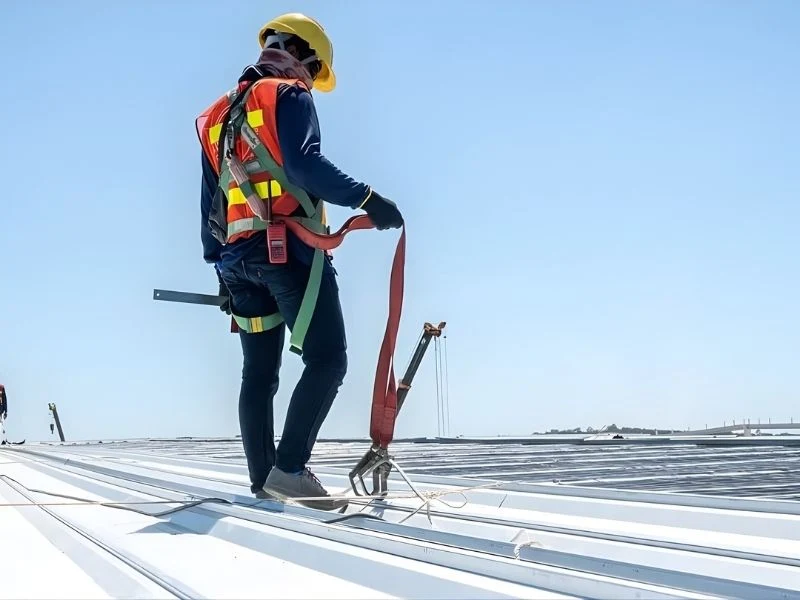
However, every element of a formal commercial roof inspection that is intended to support a maintenance decision, an insurance claim, a property transaction, or a warranty action requires a qualified professional with appropriate credentials, fall protection equipment, and liability insurance coverage. Walking a commercial roof surface without proper equipment and training creates fall risk, membrane damage from improper foot traffic patterns, and legal exposure if a worker injury occurs on the property.
The liability exposure of a building owner who attempts a DIY commercial roof inspection on a staff member or facilities worker without proper OSHA-compliant fall protection exceeds the cost of a professional inspection by orders of magnitude.
Seek immediate professional attention if any interior ceiling tile shows active discoloration after a recent rain event, if roof drain outlets are producing no discharge during or after a rain event despite observable rainfall, or if any portion of the roof membrane is visibly displaced, blistered, or separated from the substrate during a ground-level perimeter observation. These conditions indicate active or impending water intrusion that warrants a professional inspection within days rather than at the next scheduled annual interval.
Final Thoughts
Commercial roof inspection cost is one of the most favorable return-on-investment calculations available in commercial property management. The annual inspection fee for most commercial buildings represents a fraction of one percent of the roof replacement cost it protects, and the damage prevention value of finding a seam failure, a blocked drain, or a flashing separation before it becomes a full restoration project is not theoretical.
Schedule the inspection, specify the right type for the building and the purpose, and let the documentation do the work of protecting every square foot of your building. To start protecting your asset now, get a free consultation and see how early intervention can save you thousands in future repair costs.
FAQs
1. How much does a commercial roof inspection typically cost?
A: Standard professional inspections run $400 to $1,200 for most mid-size commercial buildings. Adding infrared scanning increases the cost by $500 to $2,500, depending on the roof area.
2. How often should a commercial roof be inspected?
A: Annually at a minimum, for roofs under 10 years old. Twice per year for roofs 10 years and older, and after every significant storm event, regardless of age.
3. Is a commercial roof inspection tax-deductible?
A: Generally, yes, as an ordinary and necessary business expense. Consult a qualified tax professional for guidance specific to your property ownership structure.
4: What is the difference between a visual inspection and an infrared inspection?
A: Visual inspections assess surface condition only. Infrared scanning detects moisture trapped beneath the membrane that visual inspection cannot find, making it essential after storm events.
5: Should I use the roofing contractor who bids on the repair work to also do the inspection?
A: No. Use an independent inspector with no financial interest in the repair. Contractor-performed inspections carry a conflict of interest that compromises assessment accuracy.