Solar panel cleaning brush selection is a decision that most homeowners with rooftop solar systems make once, incorrectly, and then wonder why their panels are scratched, their energy output has not recovered after cleaning, or their warranty coverage is being questioned after an installer inspection. Dirty solar panels lose between 15 and 35 percent of their rated energy output, depending on how long soiling has been allowed to accumulate, and the tool used to remove that soiling determines whether the cleaning restores full performance or introduces micro-abrasions that permanently degrade the glass surface and reduce output for the remaining life of the system.
Choosing the right solar panel clean brush for the specific panel type, mounting height, and soiling level on a residential system is a straightforward decision when the right information is available. This guide covers everything you need to know.
What is a Solar Panel Cleaning Brush?
A solar panel cleaning brush is a specialized cleaning tool designed to remove dust, pollen, bird droppings, and other soiling from photovoltaic panel glass surfaces without scratching the anti-reflective coating or leaving residue that attracts future soiling. Unlike standard household brushes, a proper solar panel clean brush uses bristle materials, stiffness ratings, and water delivery systems specifically selected to clean tempered solar glass without abrasion while reaching panels mounted at heights and angles that standard cleaning tools cannot safely access.
The brush is one component of a complete panel cleaning system that also includes a water source, a handle extension, and, in some cases, a water purification system that removes dissolved minerals before the water contacts the panel surface.
Solar Panel Clean Brush Types at a Glance
| Brush Type | Bristle Material | Water Delivery | Best Application |
|---|---|---|---|
| Soft bristle extension brush | Nylon or natural fiber blend | External hose or bucket | Ground-mounted or low-slope roof panels |
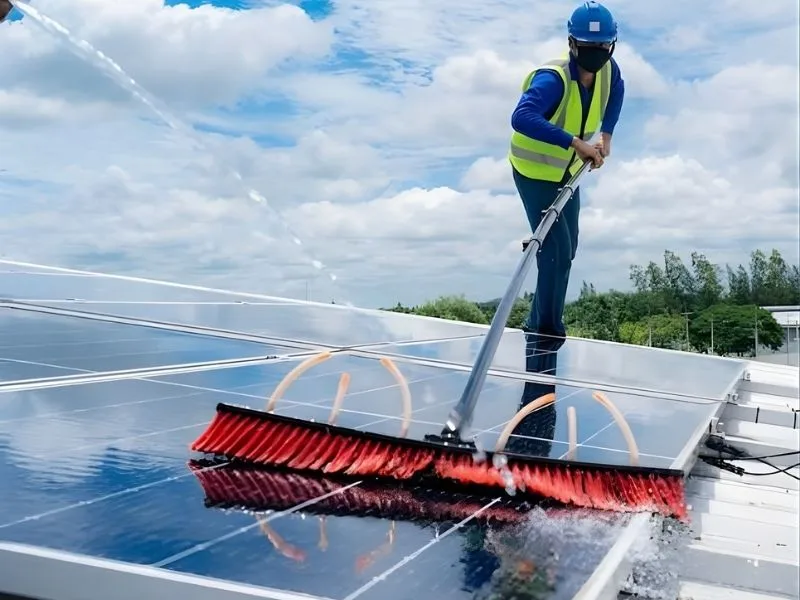
| Water-fed pole brush | Nylon with deionized water feed | Integrated water channel through the pole | All roof heights, streak-free finish |
| Rotating brush head | Soft nylon | Hose-connected or battery-powered | High soiling loads, large arrays |
| Microfiber flat brush | Microfiber pad on pivoting head | External rinse | Light dust, regular maintenance |
| Automated robotic brush | Soft polymer bristles | Built-in water system | Large commercial or frequent-clean systems |
| Telescoping handle brush | Nylon or boar hair blend | External hose | Rooftop panels accessible from ground level |
The water-fed pole brush is the most widely recommended tool for residential rooftop solar systems because it delivers purified water directly to the panel surface at the same time as the bristles agitate soiling, eliminating the mineral deposits that standard hose water leaves behind when it dries.
Why the Right Solar Panel Clean Brush Matters
The Cost of Using the Wrong Cleaning Tool
| Wrong Tool Scenario | Damage or Performance Cost | Correct Tool Cost |
|---|---|---|
| Abrasive bristle brush scratching anti-reflective coating | 5 to 15 percent permanent output loss, $500 to $3,000 long-term energy value | $40 to $150 for a correct brush |
| Hard water residue from the standard hose rinse | 3 to 8 percent output loss from mineral film buildup | $80 to $200 for a deionized water brush system |
| Pressure washer damage to panel seals and junction boxes | $300 to $1,500 per panel for seal repair or replacement | $60 to $200 for a correct extension brush |
| Standard mop or sponge micro-scratching glass | 2 to 10 percent gradual output degradation | $30 to $120 for soft-bristle solar brush |
| Cleaning with tap water leaves white deposits | Recurring soiling attraction, 4 to 9 percent output reduction | $100 to $250 for a purified water system |
Every scenario in this table represents a cleaning decision that costs more in long-term output loss or physical damage than the correct brush would have cost to purchase. Solar panels are a 25 to 30-year investment, and cleaning tool decisions made in year two affect energy production for the remaining decades of the system’s life.
The Output Recovery Value of Correct Cleaning
A residential solar system producing 10,000 kilowatt hours annually at a local rate of $0.13 per kilowatt hour generates $1,300 in energy value per year. A 20 percent soiling reduction in output costs $260 per year in lost energy value. Correct cleaning that fully restores output recovers that $260 annually for every year of the system’s remaining life. A $120 water-fed brush that enables correct quarterly cleaning delivers a return that is measured in thousands of dollars over the system’s lifespan.
Types of Solar Panel Cleaning: Know Your Options First
Different panel installations, soiling types, and homeowner access situations call for different brush configurations, and understanding the specific characteristics of each type prevents purchasing a tool that is technically a solar panel brush but functionally wrong for the specific installation. Soft nylon bristle extension brushes are the entry-level standard for residential solar panel cleaning brushes and are appropriate for ground-mounted systems and single-story rooftop installations where the panel surface is accessible from standing height with a moderately extended handle.
The bristles must be rated as soft or ultra-soft specifically for solar glass. Standard car wash or household brushes with medium or firm bristle ratings are abrasive enough to scratch anti-reflective coatings over repeated use. Water-fed pole brushes are the professional standard for residential and commercial rooftop solar cleaning because they integrate the water delivery and bristle agitation functions in a single tool that reaches panels at any roof height without requiring the cleaner to access the roof surface.
Purified water delivered through the pole channel to the brush head dissolves soiling and rinses away mineral-free, eliminating the dried residue that standard hose water leaves on the panel glass. The water purification component, typically a deionizing resin filter or a reverse osmosis cartridge, is the most important specification in a water-fed system and the component that most distinguishes a professional-grade tool from a budget imitation.
Rotating brush heads powered by the water pressure from the supply hose or by a battery motor provide mechanical scrubbing action that accelerates the removal of heavy soiling, including bird droppings, dried pollen deposits, and caked dust, without requiring the operator to apply manual pressure that might cause the brush to scratch the glass at contact points. Microfiber flat brushes work well for panels with light dust accumulation in dry climates where soiling is primarily fine particulate rather than sticky or mineral-based deposits.
The flat microfiber pad conforms to the panel surface and lifts dust into the fiber matrix without dragging abrasive particles across the glass, which is the primary scratch mechanism that standard bristle brushes create when used on a dusty panel without pre-rinsing. Telescoping handle brushes without integrated water delivery require a separate hose or bucket rinse and are the most common budget option on the residential market.
They can perform adequately when used with purified water and a proper pre-rinse sequence, but require more attention to technique than a water-fed pole system to avoid leaving mineral deposits or scratch marks from dragging dry soiling across the glass.
How to Choose and Use a Solar Panel Cleaning: Step-by-Step
Selecting and using the right solar panel cleaning brush correctly requires working through a defined sequence that matches the tool to the installation and uses it in the order that protects the panel surface.
Step 1: Assess your panel mounting height and access situation before purchasing any brush. Panels on a single-story roof accessible from the ground with a 12 to 16-foot extension can be cleaned with a standard water-fed pole brush rated to that height. Panels on a two-story roof or a steeply pitched single-story roof require a longer pole system or professional cleaning service. Never attempt to clean panels by accessing the roof surface unless you have appropriate fall protection equipment.
Step 2: Confirm your water source and mineral content before selecting a brush system. In areas with hard water, a brush system with an integrated deionizing filter is not optional. It is a necessity. Hard water dried on a solar panel leaves a white mineral film that reduces light transmission and attracts airborne particles faster than a clean glass surface. Test your tap water with a total dissolved solids meter before purchasing a brush system to determine whether a deionizing filter or reverse osmosis stage is required.
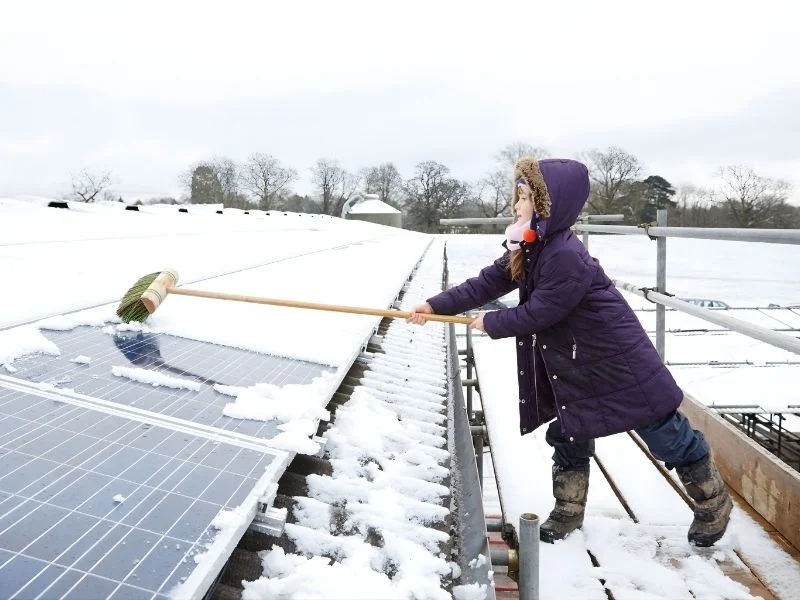
Step 3: Rinse the panel surface with purified water before any brush contact. Pre-rinsing loosens dust and debris and prevents the first brush stroke from dragging dry abrasive particles across the glass surface. Every solar panel cleaning sequence should begin with a generous rinse from the top of the panel downward before the brush makes any contact with the glass.
Step 4: Use the brush with light to moderate pressure in straight overlapping strokes from top to bottom. Never scrub in circular motions. Circular motions create swirl marks on the anti-reflective coating that scatter incoming light and reduce output. Straight overlapping strokes from the top of the panel to the bottom follow the natural drainage direction and avoid concentrating pressure on any single point of the glass surface.
Step 5: Rinse again from the top down to remove loosened soiling and brush debris. The final rinse should be generous enough to flush all soiling off the bottom edge of the panel. Soiling allowed to dry at the bottom edge of the panel creates a buildup zone that accelerates corrosion of the panel frame and reduces the output of the bottom cell row through partial shading.
Step 6: Allow panels to air dry or use a microfiber squeegee on accessible panels. Never use a standard rubber squeegee on solar panel glass, as the blade edge can scratch the anti-reflective coating. Soft microfiber squeegees rated for solar glass are available and reduce drying time, but air drying with purified water leaves no residue and requires no additional tool contact.
Solar Panel Clean Brush Selection Reference
| Panel Height | Soiling Type | Recommended Brush | Water System Required |
|---|---|---|---|
| Ground-mounted or single-story | Light dust | Soft bristle extension brush | Deionizing filter recommended |
| Single-story rooftop | Moderate dust and pollen | Water-fed pole brush | Deionizing filter required |
| Two-story rooftop | Moderate to heavy soiling | Long water-fed pole or professional service | Deionizing filter required |
| Any height | Bird droppings or heavy soiling | Rotating head water-fed brush | Deionizing filter required |
| Any height | Light dust, frequent cleaning | Microfiber flat brush | Purified water required |
Common Solar Panel Cleaning Mistakes to Avoid
Using a brush with a medium or firm bristle rating because it removes soiling faster, is the most common and most damaging cleaning mistake solar panel owners make. Bristles rated for standard surfaces that are not specifically designated as safe for anti-reflective solar glass create micro-scratches across the glass surface on every cleaning pass. These scratches scatter incoming light, reduce the panel’s light-harvesting efficiency, and accumulate over multiple cleaning cycles to produce a measurable permanent output reduction that no amount of subsequent correct cleaning can reverse.
Always verify that the bristle rating specifically states soft or ultra-soft and that the product is explicitly labeled for use on solar panel glass. Cleaning panels in direct midday sunlight causes the purified cleaning water to evaporate too quickly to complete the rinse cycle before mineral residue begins to form, and the temperature differential between the cold water and the hot glass surface creates thermal stress that can micro-crack the panel laminate over repeated cleaning cycles. Clean panels in the early morning, late evening, or on overcast days when the panel surface temperature is below 30 degrees Celsius.
Applying any cleaning chemical, soap, or detergent to solar panels without verifying that the product is explicitly rated for solar panel anti-reflective coatings voids the manufacturer’s warranty on most panels and leaves a film that attracts dust faster than clean glass. Most residential solar panels require nothing more than purified water and a soft brush. If a chemical cleaner is genuinely needed for stubborn soiling, it must be a product specifically formulated for solar glass with explicit manufacturer documentation confirming its coating compatibility.
Cleaning panels while the system is energized during daylight hours creates an electrical safety risk at the junction box and wiring connections whenever water is involved. Solar systems should be shut down at the inverter before any water-based cleaning begins, and the manufacturer’s shutdown procedure should be followed exactly.
Ignoring panel frame and mounting hardware cleaning while cleaning the glass surface leaves corrosion pathways active at the most vulnerable structural points of the installation. The aluminum frame channels where water accumulates, the mounting clamp contact points, and the conduit entry locations should all be inspected and cleared of debris during each cleaning session as part of a complete panel maintenance routine rather than a glass-only cleaning exercise.
Solar Panel Cleaning Performance Benchmarks Over Time
The performance and maintenance requirements of a solar panel cleaning brush system shift at predictable intervals that homeowners should anticipate when budgeting for long-term system maintenance. Brush systems in their first 0 to 2 years of service perform at their highest level when properly maintained and stored. The most common early-stage issues are bristle splaying from improper storage, flat rather than hanging, and deionizing filter exhaustion in areas with particularly hard water supply.
Filter cartridge replacement frequency should be calibrated to actual use volume and local water TDS levels rather than the manufacturer’s generic recommendation. Between 2 and 5 years, the bristle material on standard nylon brushes begins to stiffen slightly from UV exposure if the brush is stored outdoors. Bristle stiffness that was rated soft at purchase can migrate toward medium over time with UV degradation, increasing the scratch risk. Inspect bristle flexibility annually by pressing the brush head firmly against the back of your hand.
If the bristles feel noticeably stiffer than when new, replace the brush head before the next cleaning session. At 5 to 10 years, the water-fed pole mechanism, including the internal water channel, the swivel connections, and the flow control valve on premium systems, requires inspection for mineral scale buildup that reduces flow rate and water distribution uniformity across the brush head.
Between 10 and 15 years, most residential water-fed pole brush systems are approaching the end of their reliable service life for the mechanical components, even if the pole itself remains structurally sound. The water channel seals, swivel joints, and flow control components typically require replacement or a full system upgrade at this stage. Past 15 years, a full brush system replacement with a current-generation water-fed pole system is almost always more cost-effective than continued repair of aging components, particularly given the improvements in water purification efficiency and bristle material technology that have occurred over the preceding decade.
Technology Tools Homeowners Can Use
Modern tools have made solar panel cleaning more precise, safer, and better connected to the energy output data that confirms cleaning effectiveness. Total dissolved solids meters are inexpensive, handheld devices that measure the mineral content of tap water before it contacts the panel surface, confirming whether the deionizing filter in a water-fed brush system is performing adequately and when the filter cartridge requires replacement to maintain purified water output.
Solar monitoring apps integrated with most modern residential inverters display real-time and historical energy output data by panel string, allowing homeowners to quantify the output recovery produced by each cleaning session and identify panels that are not recovering to expected output levels after cleaning, which may indicate physical damage rather than soiling.
Drone inspection services equipped with high-resolution cameras can identify heavy soiling concentrations, bird dropping deposits, and shading from debris accumulation on rooftop panels before a cleaning session, allowing the homeowner to prioritize specific cleaning areas rather than applying uniform effort across a fully accessible array. Thermal imaging cameras used by solar service technicians detect hotspot formation in individual cells caused by shading from localized soiling deposits, identifying performance-critical cleaning priorities that panel output data alone cannot locate at the cell level.
Automated panel cleaning systems, including robotic brush devices designed for residential arrays, are increasingly available and remove the labor requirement from routine cleaning maintenance entirely, operating on a programmed schedule using purified water and soft polymer bristles that protect the panel surface while maintaining consistent cleaning intervals throughout the year.
DIY Cleaning vs. Professional Cleaning: Know the Difference
Homeowners with ground-mounted panels or single-story rooftop panels accessible from the ground with an appropriate extension pole can safely perform their own solar panel cleaning using the correct water-fed brush system and the step-by-step sequence described in this guide. This represents the majority of residential solar installations and is fully compatible with DIY maintenance when the correct tool is purchased, the deionizing filter is maintained, and the panels are cleaned during appropriate temperature and light conditions.
However, cleaning panels on two-story or steeply pitched roofs, installations requiring physical access to the roof surface, systems where individual panels show output anomalies that suggest physical damage rather than soiling, and any cleaning task that requires working near live electrical components that have not been properly shut down should be performed by a licensed solar panel maintenance contractor. Professional cleaning services for a standard residential system typically cost $100 to $300 per visit and are worth scheduling annually or semi-annually for installations where DIY access is not safe.
Seek immediate professional attention if a panel’s energy output does not recover to within 5 percent of its pre-soiling baseline within two weeks of a thorough cleaning, if visible cracks, delamination, or discoloration appear on any panel glass surface during a cleaning inspection, or if any panel frame or mounting hardware shows active corrosion, bending, or separation from the mounting rail. These are indicators of physical panel damage or installation issues that require professional assessment rather than continued cleaning and maintenance.
Final Thoughts
A solar panel cleaning brush is the least expensive component of a solar energy system and the one whose correct selection has the most direct impact on the output performance and glass longevity of the most expensive component. A $120 water-fed pole brush with a deionizing filter used quarterly on a residential system protects tens of thousands of dollars in equipment value, recovers hundreds of dollars in annual energy output, and does it without voiding the manufacturer’s warranty or scratching the glass that all of that investment depends on.
Select the right bristle rating, use purified water without exception, clean before the sun heats the glass, rinse before the first brush stroke, and the panels will perform at their rated capacity for the full 25 to 30 years they were designed to deliver. Schedule to get a free inspection and contact us today.
FAQs
1. What type of brush is safe for cleaning solar panels?
A: Soft or ultra-soft nylon bristle brushes explicitly rated for solar panel glass. Never use medium or firm-bristle brushes as they scratch the anti-reflective coating permanently.
2. Do I need a special water system with my solar panel cleaning brush?
A: Yes, in hard water areas. A deionizing filter or reverse osmosis system removes minerals that leave white deposits on the glass and reduce output when tap water dries on the surface.
3. How often should I clean solar panels with a brush?
A: Quarterly in most climates. In dusty, high-pollen, or bird-heavy environments, monthly cleaning recovers more energy value than the time and water cost of the additional sessions.
4: Can I use soap or detergent with my solar panel cleaning brush?
A: Only if the product is explicitly rated safe for solar anti-reflective coatings. Most manufacturers recommend purified water only. Unauthorized chemicals void panel warranties.
5: Should I shut down my solar system before cleaning?
A: Yes. Always shut the system down at the inverter before any water-based cleaning. Follow the manufacturer’s specific shutdown procedure before the brush contacts the panel.